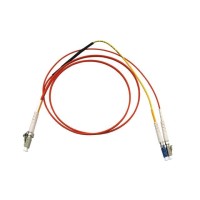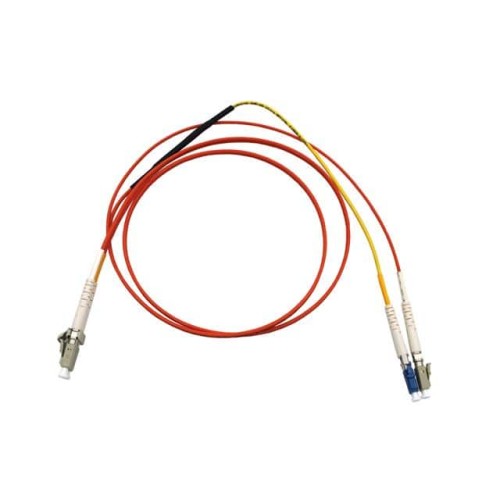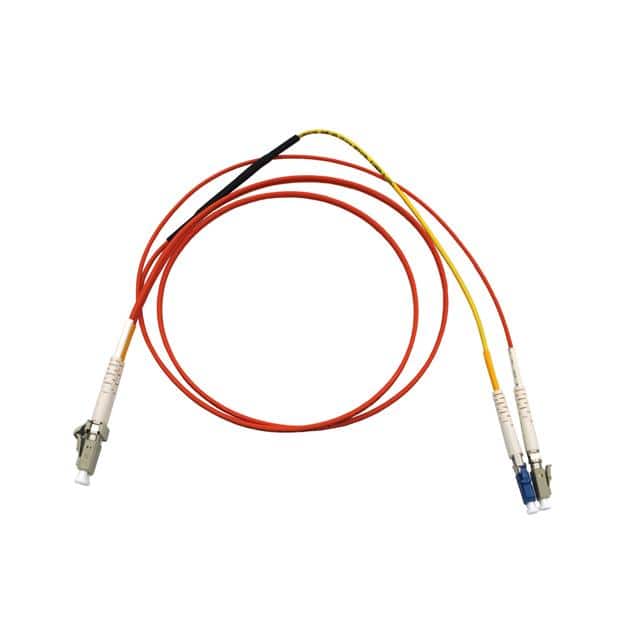
When evaluating the reliability and quality of the INFINITY FIBER 15 M, ST TO SC, DUPLEX, OM1 MODE component (SKU: I-2FOM188S15-MC), it is essential to consider the specific standards governing fiber optic patch cords and multimode assemblies. This component is a 15-meter duplex OM1 multimode fiber jumper terminated with ST connectors on one end and SC connectors on the other. The primary international reliability standards applicable here include Telcordia GR-326 for single-mode connectors and Telcordia GR-409 for multimode fiber optic components, as well as IEC 61753-1 for performance categories and TIA/EIA-568.3-D for optical fiber cabling. Qualification testing typically involves insertion loss and return loss measurements across the operating wavelength range of 850 nm and 1300 nm, ensuring compliance with typical OM1 performance limits (e.g., ≤0.75 dB insertion loss per connector pair). The component should also meet IEC 61300-3-4 for intermateability and IEC 61300-3-1 for visual inspection of end-face geometry.
Accelerated life testing (ALT) for fiber optic jumpers like this one focuses on mechanical and environmental stressors that simulate years of field use. Common ALT protocols include temperature cycling from -40°C to +85°C for 500 cycles, damp heat exposure at 85°C/85% relative humidity for 1000 hours, and vibration testing per IEC 60068-2-6. Results from these tests indicate the component’s ability to maintain stable optical performance under thermal expansion, contraction, and humidity-induced stress. A pass criterion is typically a change in insertion loss of less than 0.2 dB from baseline. For this OM1 duplex assembly, the cable jacket material (likely OFNR or LSZH) must not degrade, and the connector ferrules must resist micro-cracking. The ALT data extrapolates to a predicted service life of 15-20 years in a controlled indoor environment, but real-world factors like frequent mating cycles or cable tension can accelerate wear.
Failure rate calculations for passive fiber optic components like the I-2FOM188S15-MC are based on FIT (Failures in Time) rates, expressed as failures per 10^9 hours. For a factory-terminated, high-quality jumper, a typical FIT rate is in the range of 1-10 FITs for the cable assembly, with connectors contributing an additional 5-20 FITs per mated pair. The Mean Time Between Failures (MTBF) is derived as the reciprocal of the total FIT rate; for example, a 10 FIT assembly yields an MTBF of 100,000,000 hours (over 11,000 years). However, this is a statistical abstraction for non-repairable components—actual failures are dominated by physical damage (e.g., broken fibers at connector strain reliefs) rather than intrinsic wear-out. For procurement purposes, request the manufacturer’s reliability prediction report per Telcordia SR-332, which accounts for connector mating cycles (typically rated for 500-1000 cycles) and environmental derating factors.
Environmental stress screening (ESS) and burn-in procedures for this component are less common than for active electronics, but they are still critical for quality assurance. The recommended ESS process includes a thermal shock cycle (-10°C to +70°C, 10 cycles) followed by mechanical shock and vibration per IEC 61300-2-17. Burn-in is not a standard requirement for passive fiber optics, but 100% visual inspection of connector end-faces using a 200x-400x microscope is mandatory to detect scratches, pits, or contamination. Additionally, optical time-domain reflectometer (OTDR) testing can identify localized defects or high-loss events along the 15-meter length. For high-reliability applications (e.g., data centers or military), a 24-hour temperature cycling burn-in is sometimes performed to stabilize the connector epoxy and relieve internal stresses.
Counterfeit detection for fiber optic patch cords is challenging because counterfeits often use substandard fiber (e.g., non-OM1 grade), incorrect connector geometries, or poor-quality ferrules. Key detection methods include chromatic dispersion testing to verify the OM1 mode field diameter (62.5/125 µm) and interferometric measurement of connector end-face radius of curvature (ROC), apex offset, and fiber protrusion per IEC 61300-3-47. Genuine INFINITY FIBER products should have a laser-etched or printed part number on the boot or strain relief, with consistent font and color. Cross-reference the SKU with the manufacturer’s anti-counterfeit database or request a certificate of compliance from the authorized distributor. For OM1 duplex cables, counterfeiters may substitute 50/125 µm fiber (OM2/OM3) to save cost, which will cause mismatched performance in legacy systems. Perform a near-field mode scan or bandwidth testing at 850 nm to confirm the 200 MHz·km bandwidth specification for OM1.
Incoming inspection best practices for the I-2FOM188S15-MC should follow a sampling plan based on ANSI/ASQ Z1.4 (AQL 0.65 for critical defects). Each sample must undergo a visual inspection for connector cleanliness, cable jacket integrity, and strain relief security. Use a fiber optic microscope to inspect both ST and SC connector end-faces, flagging any defects larger than 2 µm per IEC 61300-3-35. Insertion loss testing with a stable light source and power meter must show ≤0.75 dB per connector pair, and return loss testing should exceed 20 dB for multimode. For the 15-meter length, measure the continuity with a visual fault locator and verify the duplex polarity (A-to-A, B-to-B per TIA-568). Reject any unit with visible scratches, high loss, or incorrect polarity. Document all results with photographs for traceability.
Storage and handling requirements are vital to maintain the reliability of this OM1 duplex assembly. Store the cable in a clean, dry environment at temperatures between -10°C and +60°C, with relative humidity below 85% to prevent jacket degradation. Avoid tight coiling with bend radii less than 30 mm (per OM1 specifications) to prevent micro-bending losses. Use ESD-safe handling for the connectors, as static discharge can attract dust—always install protective dust caps when not in use. For long-term storage, keep the cable in its original anti-static bag and avoid stacking heavy items on top. Label each assembly with the date of receipt and manufacturer lot code to facilitate shelf-life tracking. Periodic re-inspection (every 12 months) of stored units is recommended, especially if the environment is not climate-controlled.
End-of-life (EOL) management and obsolescence planning for the INFINITY FIBER I-2FOM188S15-MC should focus on the transition away from OM1 fiber (62.5/125 µm) to OM3/OM4/OM5 (50/125 µm) for higher bandwidth applications. As legacy 10BASE-F and 100BASE-SX networks phase out, OM1 availability may decline. Procure buffer stock for critical systems and request a product lifecycle status from the manufacturer. For new installations, consider using hybrid patch cords that support both OM1 and OM2/OM3 via mode conditioning. In the event of obsolescence, maintain a spare pool of at least 10% of the installed base for emergency replacements. Engage with INFINITY FIBER’s last-time buy (LTB) program and set up automatic alerts for discontinuation notices. For long-term maintenance, document the exact connector types (ST to SC) and fiber geometry so that compatible alternatives can be sourced quickly.