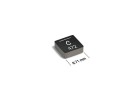
This component, specifically the KEMET A700X157M006ATE010, belongs to the category of aluminum polymer capacitors, a specialized subset of electrolytic capacitors used extensively in modern electronic systems. Unlike traditional wet aluminum electrolytic capacitors, these devices use a conductive polymer electrolyte instead of a liquid or gel. Their primary role is to provide low equivalent series resistance (ESR) and stable capacitance over temperature and frequency, making them ideal for power management applications such as voltage regulator output filtering, decoupling in DC-DC converters, and smoothing ripple currents in high-frequency circuits. In essence, they act as a high-performance reservoir and filter for electrical energy, ensuring clean, stable power delivery to sensitive loads like microprocessors, FPGAs, and ASICs.
When selecting a capacitor like the KEMET A700X, several key parameters must be meticulously evaluated. First, capacitance value and tolerance are fundamental; this part offers 150µF with a ±20% tolerance, which is typical for this type. Second, voltage rating is critical—here it is 6.3V, so it must never be exposed to sustained voltages above that. Third, ESR is arguably the most important differentiator among polymer capacitors; this specific SKU has an ESR of 10 milliohms, which is very low, enabling high ripple current handling and reduced power loss. Fourth, ripple current rating and operating temperature range (typically -55°C to +105°C or +125°C) dictate reliability under load. Finally, package size (here a 2917 SMD footprint) and height constraints matter for board layout.
Comparing the KEMET A700X to alternatives reveals clear trade-offs. Against traditional aluminum electrolytic capacitors, the polymer version offers dramatically lower ESR (10mΩ vs. often 100mΩ or more) and better stability at high frequencies and low temperatures. However, they typically have lower maximum voltage ratings (rarely above 100V) and are more expensive per unit. Against multilayer ceramic capacitors (MLCCs), polymer caps provide much higher capacitance in a given footprint (150µF vs. a few µF for a similar-sized MLCC) and are less prone to microphonic noise and DC bias derating. However, MLCCs can have lower ESR at very high frequencies and are generally cheaper for small values. Against tantalum polymer capacitors, the aluminum polymer variant is often more robust against surge currents and has a lower failure rate, though tantalum polymers can offer equally low ESR in smaller packages. In terms of cost, the KEMET A700X is mid-range—more expensive than standard aluminum electrolytics but often cheaper than equivalent tantalum polymer parts. Availability is generally good for this popular KEMET series, but lead times can fluctuate with global supply chain conditions.
Industry trends are heavily favoring components like this one. The push toward higher power density and miniaturization in electronics, especially in computing, telecommunications, and automotive applications, demands capacitors that can handle high ripple currents in small footprints. The shift to lower core voltages (sub-1V) for processors necessitates ultra-low ESR to minimize voltage droops. Furthermore, the growing adoption of polymer technology over wet electrolyte is driven by its superior lifetime and reliability, as polymer caps do not dry out over time. Another trend is the move toward higher operating temperatures (105°C and beyond) for under-hood automotive and industrial applications, which the A700X supports. Additionally, environmental regulations are phasing out certain materials, and polymer capacitors generally align well with RoHS and REACH compliance.
You should choose this specific KEMET A700X157M006ATE010 over alternatives when your design demands ultra-low ESR below 15 milliohms in a surface-mount package, combined with a capacitance of 100–330µF at 6.3V or lower. It is ideal for output filtering in point-of-load (POL) converters for CPUs, GPUs, or networking ASICs where voltage regulation tolerance is tight. It is also a strong choice when you need stable performance over a wide temperature range and cannot tolerate the derating issues of MLCCs. Avoid it if you need a voltage rating above 100V, require extremely high capacitance (e.g., >1000µF), or are cost-constrained and can tolerate higher ESR.
From a procurement perspective, several factors are vital. Lead times for KEMET polymer capacitors can range from 8 to 20 weeks depending on global demand, with high-volume automotive and server applications often consuming capacity. It is prudent to check the lifecycle status directly with KEMET or your distributor; the A700 series is mature and not nearing end-of-life, but always verify for long-term projects. For second-sourcing, consider direct alternatives from Panasonic (EEF series), Murata (ECAS series), or Nichicon (PCV series) with matching capacitance, voltage, and ESR ratings. However, note that package dimensions and ESR values may not be exact one-to-one matches, so careful PCB layout validation is required. Finally, purchasing in volume through authorized distributors ensures traceability and avoids counterfeit risks, which are particularly important for polymer capacitors due to their sensitivity to moisture and handling.