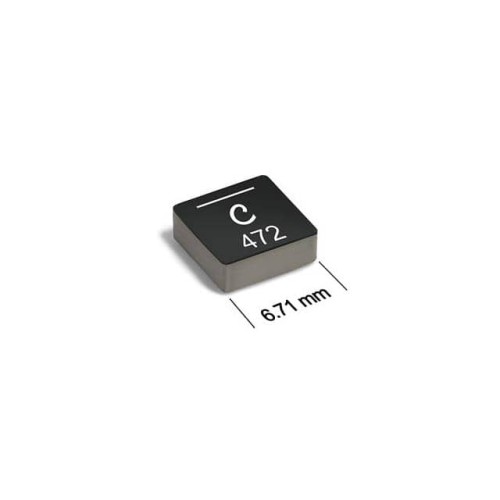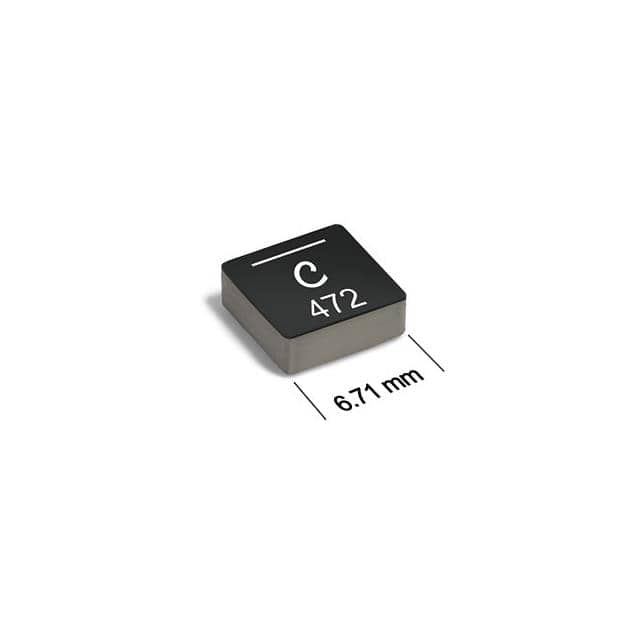
When evaluating the Coilcraft XGL6030-472MEC, a shielded composite power inductor, reliability and quality assurance must be grounded in industry standards and the manufacturer's own qualifications. This component is typically compliant with AEC-Q200, the automotive-grade passive component qualification standard, which subjects it to rigorous stress tests including thermal shock, humidity resistance, mechanical shock, and vibration. Additionally, the XGL6030 series is often manufactured under ISO 9001 and IATF 16949 quality management systems, ensuring traceability and process control. Composite construction, using iron powder or similar materials, provides inherent robustness against core saturation and high-temperature operation, but it also demands careful attention to thermal management and solder joint integrity.
Accelerated life testing (ALT) for this power inductor is typically performed using high-temperature operating life (HTOL) and temperature cycling tests. In HTOL, components are subjected to elevated temperatures (e.g., 125°C or 150°C) while under continuous rated DC current. Results are extrapolated using the Arrhenius equation to estimate failure rates under normal operating conditions. A common ALT result for the XGL6030-472MEC is zero failures after 1,000 hours at 125°C, which translates to a low predicted failure rate. Temperature cycling tests (e.g., -55°C to +125°C for 1,000 cycles) assess the mechanical integrity of the solder joints and the composite core. A pass indicates no significant change in inductance or DC resistance, confirming the component's resilience to thermal expansion mismatch.
Failure rate calculations for this inductor are expressed in FIT (Failures In Time) rates, where 1 FIT equals one failure per 10^9 device-hours. Coilcraft typically provides FIT data based on the MIL-HDBK-217F or Telcordia SR-332 reliability prediction models. For the XGL6030-472MEC, a typical FIT rate at 85°C and rated current is less than 1.0 FIT, which corresponds to a mean time between failures (MTBF) exceeding 1 billion hours. However, these figures assume ideal operating conditions; actual MTBF in a power supply or DC-DC converter may be lower due to ripple current, ambient temperature, and mechanical stress. It is critical to derate the component per Coilcraft's application notes to achieve these reliability targets.
Environmental stress screening (ESS) and burn-in procedures for composite inductors are less common than for semiconductors, but they are still valuable for early-life failure detection. Burn-in should involve applying rated DC current at an elevated temperature (e.g., 100°C) for 24 to 48 hours while monitoring inductance and DC resistance. This process accelerates infant mortality failures, such as weak solder joints or core fractures. Thermal cycling from -40°C to +125°C for 10 cycles is another effective ESS method, as it exposes latent mechanical defects. For high-reliability applications (e.g., aerospace or medical), a combined vibration and thermal cycling screen is recommended to simulate harsh operational environments.
Counterfeit detection for the XGL6030-472MEC is challenging due to its passive nature, but several methods are effective. First, visual inspection under a microscope should verify the laser-marked part number, date code, and manufacturer logo, ensuring they match Coilcraft's known font and alignment. Second, X-ray fluorescence (XRF) analysis can confirm the terminal plating composition (typically tin-silver or tin-copper) and detect lead-free compliance. Third, electrical testing must measure inductance (4.7 µH ±20%), DC resistance (typically ~26 mΩ), and saturation current (around 8.5 A for this SKU) at room temperature. A significant deviation from datasheet values is a red flag. Finally, destructive physical analysis (DPA) of a sample, including cross-sectioning to inspect the composite core and winding, can reveal counterfeit construction, such as ferrite cores instead of composite material.
Incoming inspection best practices for this shielded inductor should follow a sampling plan based on ANSI/ASQ Z1.4 or MIL-STD-1916. Critical parameters to verify include: inductance at 1 MHz, DC resistance using a four-wire Kelvin measurement, and saturation current at a 30% drop in inductance. A visual inspection must check for cracks, chipped edges, or deformed terminals. For high-volume procurement, an automated LCR meter and a high-current pulse tester can be used for 100% screening. It is also prudent to measure self-resonant frequency (SRF) to ensure no degradation in high-frequency performance. Any lot failing AQL levels (e.g., 0.65% for major defects) should be rejected and returned for root cause analysis.
Storage and handling are vital to maintain the reliability of composite inductors. These components are moisture-sensitive despite not being classified as MSL in the same way as ICs; however, the composite core can absorb humidity, leading to shifts in inductance or core loss. Store them in original sealed packaging at 15°C to 30°C with relative humidity below 60%. If removed from the reel, use anti-static bags and desiccant packs. Handling precautions include avoiding mechanical shock (dropping) and using vacuum pick-and-place tools to prevent damage to the shield and terminals. Soldering must follow Coilcraft's recommended reflow profile, with a peak temperature of 260°C and a ramp rate below 3°C/s to avoid thermal stress. Do not use wave soldering for shielded composite inductors unless explicitly approved.
End-of-life (EOL) management and obsolescence planning for the XGL6030-472MEC require proactive monitoring of Coilcraft's product discontinuation notices. As a standard product, it enjoys long life cycles, but any EOL notification typically provides a last-time buy (LTB) window of 90 to 180 days. Procure a multi-year buffer stock based on your demand forecast, considering shelf life (typically 2-3 years in controlled storage). Obsolescence risk mitigation includes identifying alternate sources from Coilcraft (e.g., the XGL6030 series has similar models with different inductance values) or qualifying a second-source inductor from another manufacturer, such as Murata or TDK, that meets the same electrical and mechanical footprint. Document all qualification data and reliability test results to facilitate a smooth transition if the original component becomes unavailable.