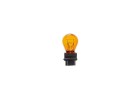
The Interlight MINIATURE .69 AMPS 13V WEDGE, SKU WW-JAXE-9, is a specialized incandescent lamp designed for indicator and illumination applications in tight spaces. To fully understand this component, one must first decode the part number which reveals its key electrical specifications. The "13V" indicates a nominal operating voltage of 13 volts DC or AC RMS. The ".69 AMPS" (690 milliamps) is the nominal current draw at this voltage. Using Ohm's Law (P = V x I), this translates to a nominal power consumption of approximately 9 watts. In practice, this means the lamp is designed to provide a specific luminous flux when driven at exactly 13 volts. The "WEDGE" describes the base style, a T5 or T6.5 wedge base, which is a glass envelope with two wire leads that are pressed into a plastic or metal socket. The "MINIATURE" designation confirms its compact size, typically about 19mm in length and 6.5mm in diameter. Engineers must understand that the rated voltage is the design center; a 13V lamp operating at 12V will produce significantly less light and have a longer life, while operating at 14V will produce more light but drastically shorten its lifespan, following a power law relationship typical of incandescent filaments.
The absolute maximum ratings for this component are critical for ensuring reliability and preventing catastrophic failure. The most important absolute maximum rating is the maximum operating voltage, which should not exceed 14.5V for sustained periods. Exceeding this can cause the tungsten filament to sag, vaporize more rapidly, or even rupture. The maximum operating current is inherently tied to voltage, but inrush current must be considered. At turn-on, the cold filament has a much lower resistance (about 1/10th of its hot resistance), causing a surge current that can be 10 times the nominal .69 amps. This inrush must be factored into the power supply design and any series protection components. The maximum ambient temperature is typically rated at 85°C; exceeding this can cause the glass envelope to soften or the base to melt. Derating is essential for extended life. For every 10% reduction in operating voltage below 13V, the expected life can increase by a factor of 3 to 5. Conversely, a 5% increase in voltage can halve the life. Engineers should derate the voltage by 5-10% when designing for 24/7 operation or high-vibration environments. There is no reverse polarity concern for incandescent lamps, but AC or DC operation is permissible as long as the RMS voltage remains within the 13V nominal range.
Typical application circuits for the WW-JAXE-9 are straightforward but require careful consideration of the power source. The most common circuit is a simple series connection between a regulated 13V DC power supply and the lamp. However, in automotive or industrial environments, this lamp is often used in a 12V system. Here, a series resistor may be required to drop the voltage from 14V (typical alternator output) to 13V. Using Ohm's Law, if the supply is 14.4V and the lamp draws .69A at 13V, the resistor must drop 1.4V. The resistance value is R = V/I = 1.4V / 0.69A = 2.03 ohms, and the power rating must be at least P = V x I = 1.4V x 0.69A = 0.966W, so a 2W resistor is recommended for margin. For dimming, a PWM (Pulse Width Modulation) controller is the preferred method, operating at a frequency above 100 Hz to avoid visible flicker. The lamp's thermal inertia makes it respond to the average voltage, so a 50% duty cycle at 13V yields an effective voltage of about 6.5V. A simple RC filter can be added to smooth the PWM signal if electromagnetic interference is a concern. In critical applications, a current-limiting fuse of 1A or 1.5A should be placed in series to protect against short circuits or filament failure.
The pin configuration of the WW-JAXE-9 is defined by its wedge base. The base consists of two parallel wire leads (pins) that exit the bottom of the glass envelope. These pins are unlabeled and are electrically identical; there is no polarity, so the lamp can be inserted either way into the socket. The critical package consideration is the mechanical fit. The wedge base is designed to be held by friction in a plastic or metal socket, often with a locking tab. The overall length from the tip of the glass to the end of the pins is typically 1.1 inches (28mm), and the glass bulb diameter is 0.625 inches (15.9mm). Engineers must ensure the socket provides adequate clearance for the glass envelope and that the pins are not bent during insertion. The glass envelope is made of soda-lime glass, which can withstand thermal shock but is not shatterproof. For environments with vibration, a silicone rubber socket is recommended to dampen mechanical stress on the filament. The lamp does not have an integral heat sink; all heat dissipation is through radiation and convection from the glass envelope. No additional heat sinking is required, but airflow should be considered to prevent heat buildup in enclosed fixtures.
Thermal management for this miniature lamp is largely passive but must account for the high filament temperature (approximately 2200°C to 2500°C). The primary concern is the glass envelope temperature, which can reach 200°C to 300°C during operation. This requires that any nearby components, wiring, or plastic housings be rated for such temperatures. A minimum air gap of 1/4 inch (6mm) around the bulb is advisable for convective cooling. In enclosed fixtures, the ambient temperature inside the enclosure can rise significantly, leading to accelerated aging. A derating curve is essential: for every 10°C increase in ambient temperature above 25°C, the lamp's life can decrease by 20-30%. If the lamp is mounted near heat-sensitive components like capacitors or semiconductors, a thermal barrier or heat shield may be necessary. The filament's thermal time constant is very short (milliseconds), so it responds almost instantly to voltage changes. This means that repeated on-off cycling creates thermal stress from expansion and contraction, which can cause filament fatigue. For applications with frequent switching, a soft-start circuit that ramps up voltage over 100-200ms can dramatically extend life.
The timing diagrams or characteristic curves for this lamp are typically presented as light output vs. voltage and life vs. voltage plots. The light output curve is non-linear; a 10% reduction in voltage (to 11.7V) can result in a 30-40% reduction in luminous flux, while a 10% increase (to 14.3V) can increase light output by 50-60%. The life curve follows an exponential decay: at 13V nominal, the rated life is typically 1000-2000 hours. At 12V, life can exceed 5000 hours, but at 14V, life plummets to under 200 hours. The warm-up time is essentially instantaneous, reaching 90% of full brightness within 50 milliseconds. There is no significant rise or fall time to interpret; the lamp behaves as a pure resistive load with a low thermal mass. The current vs. voltage curve shows a positive temperature coefficient: as the filament heats, its resistance increases, so the current is not proportional to voltage. At 6.5V (half voltage), the current will be about 0.4A, not 0.345A, due to the cooler filament resistance. This must be considered when designing dimming circuits or calculating power dissipation. The most critical curve to interpret is the life vs. temperature derating, which shows that ambient temperatures above 50°C can halve the rated life, making thermal management paramount for long-term reliability.